
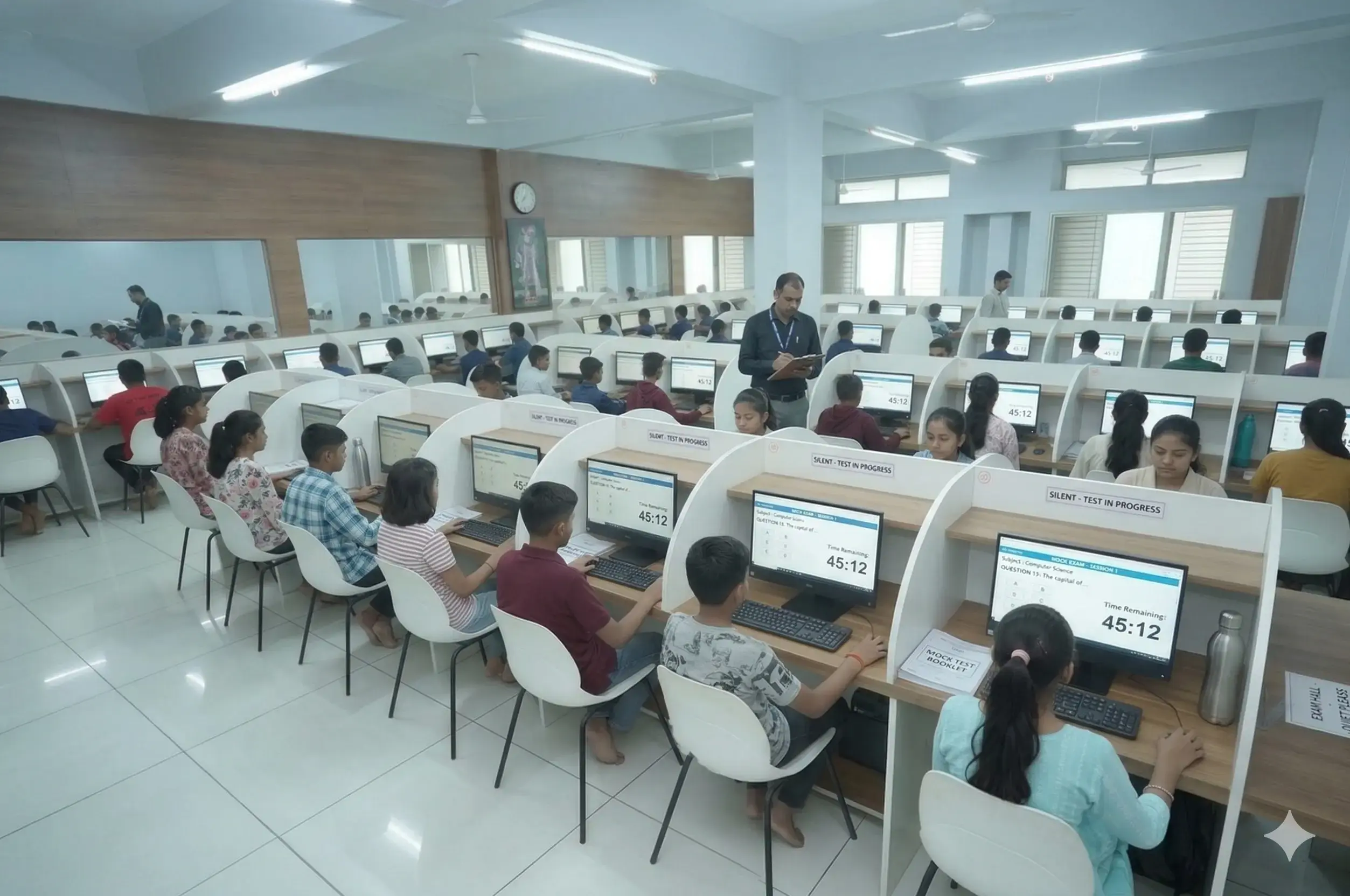
JEE Advanced is fundamentally different from JEE Main. While Main tests breadth of knowledge, Advanced tests depth of conceptual understanding and advanced problem-solving skills. The bar for 250+ is extremely high — you need to score in the 95+ percentile to crack IIT admission cutoffs. This requires a sophisticated mock test strategy backed by data-driven analysis.
Based on analysis of 30,000+ JEE Advanced attempts on NES, students who score 250+ follow a specific framework: structured concept mastery, strategic mock test selection, and rigorous error analysis. This guide reveals that exact framework.
The 250+ Reality: Only 4-5% of JEE Advanced test-takers score 250+. The average attempt includes 20-25% silly mistakes, 30-35% concept gaps, and 40-45% incomplete attempts. To reach 250+, you must reduce each of these to under 10%, 10%, and 5% respectively. This is a precision game.
Why Standard Mock Tests Don't Work for Advanced
The biggest mistake JEE Advanced aspirants make: treating Advanced like a scaled-up version of Main. They take easy mock tests, score 200+, then get crushed in the real exam because the difficulty gap is immense.
Here's the difference:
| Aspect | JEE Main | JEE Advanced |
|---|---|---|
| Straightforward concept questions | 40% | 5% |
| Multi-step reasoning needed | 40% | 70% |
| Novel problem types (unseen before) | 15% | 25% |
| Calculation/Algebra intensive | 5% | 0% |
| Testing mere formula application | 30% | 0% |
In JEE Advanced, you cannot succeed by memorizing formulas or standard problem types. You must understand principles so deeply that you can solve completely novel problems by first principles. This demands a different preparation approach and a different type of mock test.
💡 Real Talk: If you're scoring 200 in JEE Main mock tests, expect to score 120-140 in properly-difficulty-matched JEE Advanced mocks. This doesn't mean you're unprepared — it means JEE Advanced is a different beast. Many top Main scorers fail to transition to Advanced because they underestimate this gap.
The 4-Phase Mock Test Strategy for 250+
Phase 1: Diagnostic Mocks (Weeks 1-4)
Take a full JEE Advanced mock without any recent preparation. Your only goal is to identify knowledge gaps, not to score well. This diagnostic mock is your X-ray — it reveals your weaknesses before you start intensive preparation.
In your analysis of this first mock, categorize every single error:
- Category A (Concept Gaps): You attempted the question but selected the wrong answer due to incomplete understanding.
- Category B (Careless Errors): You knew the concept but made a silly calculation or reading error.
- Category C (Time/Attempt Issues): You didn't attempt the question or ran out of time.
- Category D (Novel Problem): The question type was completely new to you.
Most students only count Category A (wrong answer). Successful students analyze all four categories. Category B errors (silly mistakes) can account for 15-20 marks that you're "already capable of" but losing due to carelessness. That alone can shift you from 200 to 220.
Phase 2: Targeted Concept Building (Weeks 5-12)
Once you know your weaknesses, this phase is about deep concept revision guided by mock test data. Instead of studying chapters sequentially, prioritize based on what actually costs you marks in mocks.
For each weak topic, follow this protocol:
- Concept Mastery (2-3 days): Go back to NCERT and advanced texts. Study the topic from first principles. Watch advanced video explanations if needed. Take detailed notes.
- Problem Variety (2-3 days): Solve 40-50 problems of this topic across varying difficulty levels. From easy recap questions to JEE Main-level to JEE Advanced-level.
- Deeper Insights (1 day): After solving many problems, identify patterns in how examiners test this topic. What angles do they always test? What edge cases appear repeatedly?
- Mini-Mock Validation (1 day): Take a focused mini-mock (8-10 questions) exclusively on this topic. You must score 80%+ before moving to the next topic.
Phase 3: Integrated Problem-Solving (Weeks 13-20)
Now that individual topics are stronger, take full-length JEE Advanced mock tests every 3-4 days. The goal here is not to score your best — it's to practice strategic decision-making under exam conditions.
Key practices during this phase:
- Attempt Strategy: In JEE Advanced, you cannot solve every question. Decide upfront: which questions will you attempt? Which will you skip? Time allocation matters enormously.
- Selective Guessing: With negative marking, when should you guess vs. skip? This is a mathematical question with a specific answer based on your confidence level and question difficulty.
- Section Management: Should you attempt physics first or chemistry? Some students find momentum in physics, others in chemistry. Test different section orders in mocks to find your optimal flow.
After each full mock, spend 3+ hours on analysis. Your mock test analysis is more valuable than the mock itself.
Phase 4: Performance Optimization (Weeks 21-26)
The final phase is about eliminating Category B errors (silly mistakes) and optimizing time allocation. You should be taking a full mock every 2-3 days and seeing measurable improvement week over week.
Focus areas:
- Arithmetic Accuracy: Even brilliant physicists lose marks due to calculation errors. Practice mental math and verification techniques.
- Reading Carefully: Chemistry especially requires reading question statements 2-3 times. The difference between "X is not formed" and "X is primarily formed" changes the answer.
- Time Pressure Resilience: In your last 5-7 mocks, practice intentionally making faster decisions to see how your accuracy changes under time pressure.
The Mock Test Reality Check: If you're averaging 180 in your mocks and exam day comes, expect 170-190 in the actual test. Exam day pressure, unfamiliar test center environment, and harder actual papers all contribute to a 10-20 mark dip. Plan accordingly.
Advanced Problem-Solving Techniques Specific to JEE Advanced
Technique 1: The First-Principles Approach
JEE Advanced loves asking novel questions that cannot be solved by memorized formulas. When you encounter an unfamiliar problem:
- Don't immediately look for a formula
- Instead, identify the fundamental principles involved (Newton's laws, conservation laws, equilibrium principles, etc.)
- Build the solution from these first principles
- Verify your answer makes physical sense
Example: If asked about an unusual pulley system you've never seen before, don't panic. Use Newton's second law and constraint equations to solve it step by step. This is what JEE Advanced tests.
Technique 2: The Dimensional Analysis & Limiting Case Check
Before finalizing any answer, ask yourself:
- Does the dimension match? (If the answer should be velocity, is it m/s, not m or s?)
- Do limiting cases make sense? (If I set one parameter to zero, does the formula still make sense?)
- Does the magnitude seem reasonable? (A human's acceleration shouldn't be 10^8 m/s^2)
These checks catch conceptual errors that formulas alone wouldn't reveal.
Technique 3: The Multi-Path Solution
For complex JEE Advanced problems, solve using at least 2 different methods if time permits. If both methods give the same answer, you're confident. If they differ, you found a mistake before submitting.
Chemistry-Specific Mock Test Strategy
Chemistry in JEE Advanced is the trickiest section for many students. Questions test depth of reaction mechanisms, not just memorization of reactions.
| Chemistry Topic | Advanced Focus | Mock Test Tip |
|---|---|---|
| Organic Reactions | Mechanism, not just reaction | After each mock, redraw mechanisms for incorrect answers |
| Coordination Chemistry | Crystal field theory, isomerism | Practice drawing crystal field diagrams under time pressure |
| Electrochemistry | Nernst equation, complex calculations | Focus on calculation accuracy — this is where marks are lost |
| Thermodynamics | Gibbs free energy applications | Understand ΔG = ΔH - TΔS intuitively, not just as a formula |
Physics-Specific Mock Test Strategy
Physics in JEE Advanced rewards those who deeply understand concepts. Mock analysis should focus on:
- Electromagnetism: This is the highest-scoring section. The gap between a student who truly understands Maxwell's equations and one who memorizes formulas is massive.
- Mechanics: Advanced mechanics questions use lagrangian mechanics and constraint forces — require first-principles thinking.
- Modern Physics: Usually straightforward if concepts are clear. Focus here to build confidence.
💡 Physics Insight: In advanced physics problems, the algebra is often messy. Don't get discouraged if your derivation is complex. Instead, verify it makes dimensional sense and gives correct limiting cases. Advanced usually tests problem-solving approach, not calculation perfection.
The Critical Mock Test Analysis Framework
Your analysis protocol after every full mock should take 90-120 minutes minimum:
Step 1: Error Categorization (30 minutes)
For every wrong answer, note: Category (A/B/C/D), topic, difficulty level (easy/medium/hard), and root cause. Create a spreadsheet tracking this.
Step 2: Topic Performance Review (20 minutes)
Which topics are you consistently weak on across multiple mocks? These are your priority revision areas for the next week.
Step 3: Attempt Strategy Review (20 minutes)
Which questions did you skip? Did you correctly identify them as too hard? Or did you skip incorrectly-easy questions? Refine your question selection strategy.
Step 4: Calculation Error Analysis (10 minutes)
Track calculation errors separately. If you're losing 5+ marks per mock to arithmetic, implement verification checks.
Step 5: Re-solving (20 minutes)
Completely re-solve all incorrect questions. Note where your original approach differed.
The Final 7-Day Sprint Before JEE Advanced
- Days 1-2: Take 1 full mock. Analyze weaknesses. Do targeted revision on your 3 weakest topics. Light practice only.
- Days 3-4: Rest from full mocks. Revise formulas and key concepts. Solve 20 advanced-difficulty problems from your weak topics only.
- Days 5-6: Take 1 light practice mock (skipping topics you're strong in). Get familiar with test interface again.
- Day 7: Complete rest. Light formula revision only. Mental preparation.